The 21st Century ROAD to Housing Act Is Now Law — What NJ Buyers Need to Know
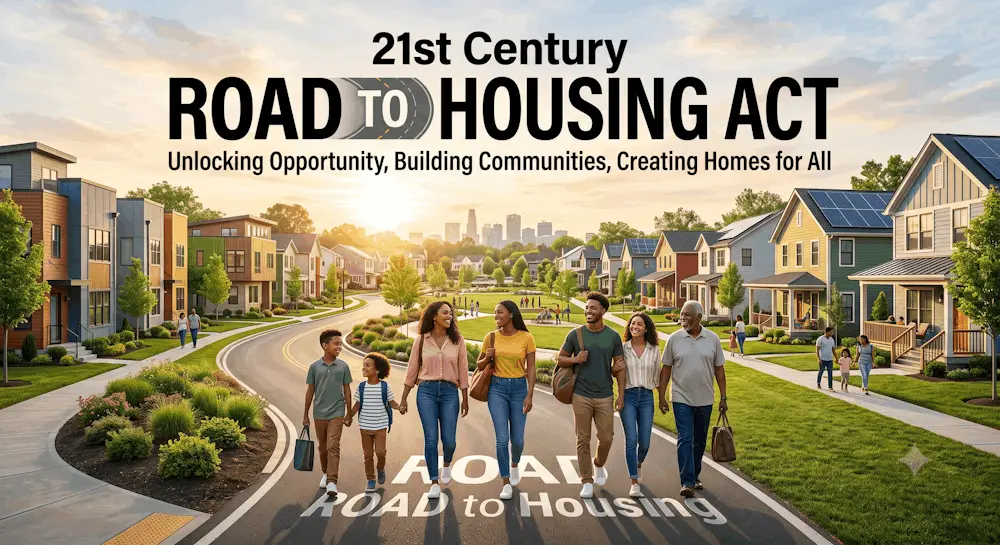
Congress Just Passed the Biggest Housing Reform in Years — Here's What It Means for NJ Buyers
The 21st Century ROAD to Housing Act (H.R. 6644) became law on July 11, 2026. It restricts corporate investors, reforms VA and FHA mortgage access, and creates $200M in annual incentives for towns that build more homes.
For most of the past decade, federal housing policy moved slowly while buyers competed in a market defined by shrinking supply, rising institutional investor activity, and mortgage products that hadn't kept pace with real-world prices. That changed on July 11, 2026.
The 21st Century ROAD to Housing Act (H.R. 6644) passed the Senate 85–5 and the House 358–32 before being signed into law — bipartisan margins that signal broad agreement on what's been broken. The bill consolidates more than 60 pieces of housing legislation into a single law spanning 12 titles: from supply incentives and manufactured housing reform to veteran loan access and a landmark restriction on corporations buying single-family homes.
Not every provision has immediate impact. Some create pilot programs that take years to spin up. Others require municipalities to apply for competitive grants. But several sections are direct, concrete wins for New Jersey home buyers right now — and as a Monmouth County broker associate who's been watching this market tighten for years, I want to walk you through exactly what this law does and doesn't do.
What "ROAD" stands for: The original legislation was introduced as two separate bills — the ROAD to Housing Act (Senate) and the Housing for the 21st Century Act (House). The combined final law carries the merged name. The bill (H.R. 6644) is publicly available on GovInfo.gov for anyone who wants to read the full enrolled text.
1. Corporations Can No Longer Compete Against You for Single-Family Homes
This is the provision that will matter most to NJ buyers in the near term, and it's exactly what buyers have been asking for.
Large institutional investors that directly or indirectly own 350 or more single-family homes are now prohibited from purchasing additional single-family homes. A renter outreach resource will be established at HUD to help tenants of institutional investor-owned properties navigate landlord disputes. Note: An exception exists for build-to-rent new construction.
NJ has seen significant institutional investor activity in communities like Toms River, Lakewood, and parts of Middlesex County. With corporate buyers now legally restricted from adding to existing portfolios of 350+ homes, NJ buyers face fewer deep-pocketed all-cash competitors in the single-family market.
✅ Still Permitted
- Individual homeowners (any number)
- Small landlords (under 350 homes)
- Build-to-rent new construction
- Institutional investors selling existing holdings
🚫 Now Restricted
- Entities owning 350+ SFH purchasing any more
- Corporate portfolio expansion in existing SFH stock
- Institutional buyer competition at the listing level
2. Towns That Build More Homes Get Paid — Towns That Don't, Don't
New Jersey has one of the most restrictive zoning landscapes in the United States. Decades of exclusionary single-family-only zoning, lengthy municipal approval processes, and NJ's Mount Laurel affordable housing obligations have created a system that is structurally hostile to new housing construction. The ROAD Act creates a direct financial incentive to change that.
Creates a $200 million annual competitive grant program for local governments and tribes that demonstrate measurable increases in housing supply. Qualifying reforms include streamlined permitting, density bonuses, and zoning changes. The program runs for seven years.
NJ's 565 municipalities compete for limited resources. The Innovation Fund creates a real financial incentive for towns to approve more housing. Communities like Red Bank and Long Branch — which have already embraced mixed-use infill development — are well-positioned to apply.
Ties some Community Development Block Grant (CDBG) allocations to housing production levels. Localities that exceed targets get bonuses; lagging grantees see small reductions. CDBG funding is now allowed to be used directly for new affordable housing construction (Sec. 204).
This is a carrot-and-stick mechanism. NJ municipalities that have resisted housing development risk losing federal funding they rely on for community projects.
HUD is directed to publish guidelines and best-practice frameworks for state and local zoning. The NEPA environmental review process for federally supported housing activities is streamlined through expanded categorical exclusions, reducing approval timelines for residential projects.
Faster federal review = faster local construction timelines for affordable housing projects in NJ communities.
3. NJ's 400,000+ Veterans Just Got a Clearer Path to Homeownership
The VA Home Loan is one of the most powerful mortgage products available to American home buyers: no down payment, no private mortgage insurance, and competitive rates. Yet study after study finds that eligible veterans consistently underutilize it — often because no one told them they qualified.
Every lender issuing a Uniform Residential Loan Application must now include a disclosure informing all applicants that they may be eligible for a VA Home Loan. This disclosure appears at the beginning of the mortgage process — before the buyer has committed to a loan type.
New Jersey has approximately 400,000 veterans. Many are currently financing home purchases with conventional or FHA loans and paying private mortgage insurance they wouldn't owe under a VA loan. This disclosure requirement alone could redirect thousands of NJ veteran buyers into zero-down VA financing.
Enhances FHA mortgage disclosures to help borrowers directly compare VA loan options alongside conventional and FHA products in a side-by-side format.
When an NJ veteran can see that a VA loan eliminates their $500/month PMI payment, the decision becomes clear. The VALID Act makes that comparison unavoidable.
For NJ veterans currently renting: If you served and haven't explored VA eligibility, this law is a direct signal to check your Certificate of Eligibility. Zero down payment on a $400,000–$800,000 purchase in Monmouth County is a genuinely different financial picture than 3–5% down on a conventional loan. Call my office and I'll walk through it with you: (732) 222-6336.
4. Appraisal Reform Protects NJ Buyers in Fast-Moving Markets
In a market where homes sell in 16 days at 102.4% of asking price — as Monmouth County did in June 2026 — appraisal gaps are a real transaction risk. You agree to pay $875,000 for a home; the appraisal comes in at $840,000; the deal is suddenly in jeopardy. The ROAD Act addresses this from two angles.
Requires USDA, VA, FHA, and FHFA to implement lender procedures for value reconsiderations or second appraisals requested by consumers on federally backed mortgages. Previously, challenging an appraisal was largely at the lender's discretion and inconsistently administered.
NJ buyers who receive a low appraisal on an FHA, VA, or USDA loan now have a standardized right to request reconsideration — a meaningful protection in a market where comp selection can make or break a $50,000 price gap.
Reforms appraisal licensing and training requirements, adds flexibility for trainee appraisers, and authorizes federal grants to support appraisal workforce development. The appraiser shortage — particularly in rural and underserved areas — has been a documented contributor to appraisal delays and gaps.
Parts of Ocean County, Monmouth's rural areas, and coastal communities have experienced appraisal delays that slow closings. More licensed appraisers = faster, more accurate valuations.
5. More Mortgage Options for More NJ Buyers
Allows HUD to establish a pilot program expanding access to FHA-backed mortgages under $100,000 — a segment of the market where loan origination costs historically made lending unprofitable. The pilot runs for four years.
Relevant for NJ buyers in markets like Keansburg, parts of Asbury Park, and other entry-level coastal communities where properties in the $200K–$400K range can create a small-dollar secondary financing need, or for buyers combining with down payment assistance programs.
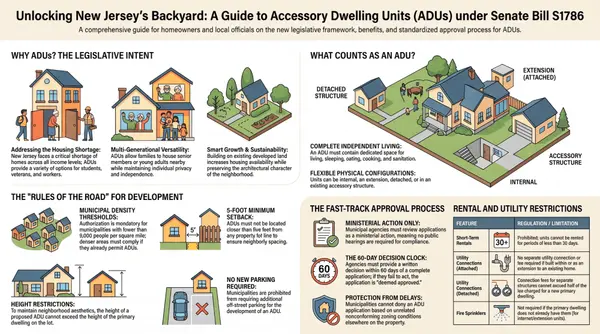
Increases the loan limits for FHA-insured manufactured housing loans and adds the construction of accessory dwelling units (ADUs) as an acceptable use for FHA-insured property improvement loans.
ADUs — garage apartments, backyard cottages, finished basement units — are an increasingly popular strategy for NJ homeowners who want to house a family member or generate rental income. FHA-backed ADU financing makes this significantly more accessible.
Creates a HUD pilot program to support state, local, and tribal whole-home repair programs — providing grants and forgivable loans to homeowners and landlords for home repairs and modifications.
Older NJ housing stock (Asbury Park, Long Branch, Neptune, parts of Red Bank) often requires significant renovation investment before or after purchase. Whole-home repair grants could enable buyers who purchase distressed properties to fund necessary improvements — and help existing homeowners bring deferred-maintenance properties to market.
Why This Law Matters in the Current Monmouth County Market
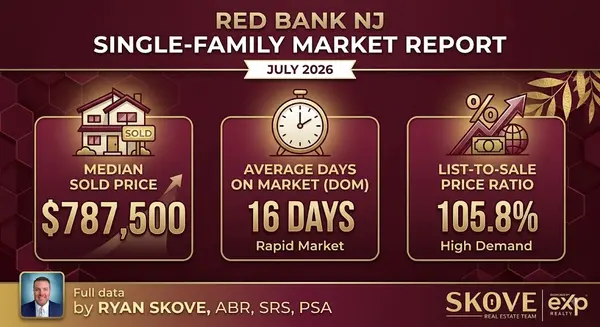
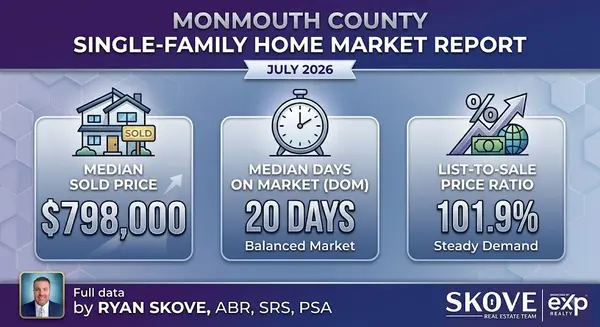
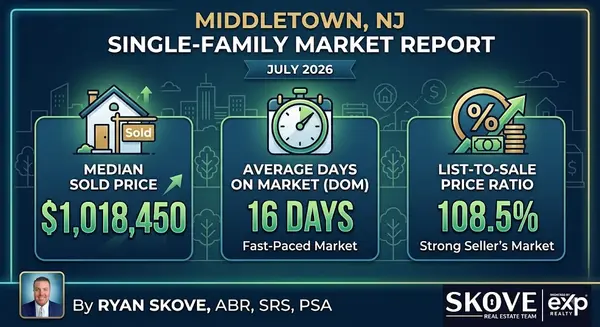
To understand why this legislation matters, it helps to see where the NJ market has been heading — and what's been driving it.
Monmouth County SFR median sold price has increased 19.8% over three years, driven primarily by constrained supply. The ROAD Act's supply incentives and investor restrictions target both root causes.
The supply math: Monmouth County currently has 2.57 months of housing inventory — well below the 6-month balanced-market threshold. In June 2026, 679 new contracts were signed against 874 new listings, a ratio that keeps upward pressure on prices. The ROAD Act's most durable impact for NJ buyers is on supply: if the Innovation Fund, CDBG incentives, and streamlined NEPA reviews translate into 500–1,000 additional housing units per year in Monmouth County over the next decade, the math on appreciation moderates meaningfully.
What the ROAD Act Does NOT Do (Be Clear-Eyed About This)
Every major housing bill generates optimism — and sometimes overstated expectations. Here's what the law does not include, so you can plan accordingly:
| What Buyers Often Expect | What the ROAD Act Actually Does |
|---|---|
| Direct down payment assistance grants | No direct DPA program. VA loan access improved; FHA small-dollar mortgages expanded via pilot. NJ's NJHMFA programs remain the primary DPA source. |
| Immediate rent or price reductions | Supply incentives and investor restrictions take years to fully translate into market prices. No price controls are included. |
| A blanket ban on all investors buying homes | Only institutional investors owning 350+ SFH are restricted. Small landlords, family investors, and REITs with smaller portfolios are unaffected. |
| Nationwide zoning reform | HUD publishes guidelines and best practices; municipalities aren't required to adopt them. The financial incentives (Innovation Fund, CDBG) are the levers. |
| Mortgage rate relief | The Act does not address interest rates, which remain set by the Federal Reserve and market forces. |
"This is the most comprehensive federal housing legislation in a generation. It won't fix the NJ market overnight — but it creates the structural conditions for supply to grow and institutional competition to shrink. For buyers, that's a generational tailwind worth understanding."
— Ryan Skove, ABR®, SRS, PSA | Broker Associate, eXp Realty | Red Bank, NJWhen Do These Changes Take Effect?
The law was signed on July 11, 2026. Different provisions have different implementation timelines:
- Institutional Investor Restriction (Sec. 1001) — Effective upon enactment. Large corporate investors owning 350+ SFH cannot purchase additional single-family homes starting now.
- Military Service Disclosure (Sec. 601) — HUD and lenders will need to update the Uniform Residential Loan Application. Expect 90–180 days for full lender implementation.
- Innovation Fund (Sec. 208) — HUD must establish the grant program; municipalities apply competitively. First grant awards likely 12–18 months from enactment.
- FHA Small-Dollar Mortgage Pilot (Sec. 105) — HUD will establish the pilot program. Timeline for implementation: 6–12 months.
- Appraisal Reconsideration Procedures (Sec. 704) — Federal agencies must establish procedures; estimate 6–12 months for final rules.
- Whole-Home Repairs Pilot (Sec. 202) — HUD must establish the program and award grants to states/municipalities. 12–24 months before reaching borrowers.
Frequently Asked Questions
What is the 21st Century ROAD to Housing Act?
The 21st Century ROAD to Housing Act (H.R. 6644) is a comprehensive bipartisan federal housing law signed in July 2026. It consolidates over 60 pieces of housing legislation across 12 titles, addressing housing supply, affordability, manufactured housing, veteran housing access, FHA and VA mortgage reform, and restrictions on institutional investors buying single-family homes.
When did the 21st Century ROAD to Housing Act become law?
The Act became law on July 11, 2026. The Senate passed it 85–5 on June 22, 2026, and the House passed it 358–32 on June 23, 2026, making it one of the most bipartisan housing bills in recent congressional history.
How does the ROAD Act restrict institutional investors from buying homes?
Section 1001 — "Homes Are for People, Not Corporations" — prohibits institutional investors that directly or indirectly own 350 or more single-family homes from purchasing additional single-family homes. There is an exception for build-to-rent new construction. HUD must also establish a renter outreach resource for tenants of investor-owned properties.
Does the ROAD to Housing Act help NJ veterans buy homes?
Yes — significantly. Section 601 now requires all mortgage lenders to disclose VA loan eligibility on the Uniform Residential Loan Application. Section 603 (VALID Act) requires FHA lenders to show a side-by-side comparison of VA loan options. With over 400,000 veterans in New Jersey, many of whom are currently paying PMI on conventional loans they didn't need, this could redirect thousands of NJ veteran buyers into zero-down VA financing.
Does the ROAD Act include down payment assistance for NJ buyers?
Not directly. There is no standalone DPA grant program in the Act. However, the law expands access to VA loans (which require zero down payment), improves access to FHA small-dollar mortgages, and creates ADU financing options through property improvement loans. For direct down payment assistance in NJ, the NJHMFA First-Time Homebuyer Mortgage Program remains the primary resource.
How will the ROAD Act increase housing supply in New Jersey?
The Act uses financial incentives rather than mandates. The $200M annual Innovation Fund rewards municipalities that increase housing supply through streamlined permitting, density bonuses, or zoning reforms. CDBG funding is now tied to housing production levels, creating a carrot-and-stick dynamic for NJ's 565 municipalities. Streamlined NEPA reviews reduce federal approval timelines for housing projects. The full supply impact will take several years to materialize but represents a genuine structural change in federal housing incentives.
Will the 21st Century ROAD to Housing Act lower home prices in New Jersey?
Not immediately. The institutional investor restriction could reduce corporate competition in the near term. Supply-building incentives take years to translate into new listings. This law is best understood as a structural improvement to the conditions that drive NJ's housing affordability crisis — not a price correction. If you're waiting for prices to fall before buying, the data doesn't support that strategy: Monmouth County SFR values have appreciated 19.8% over the past three years with no sign of reversal.
Ready to Buy in the New Landscape?
The ROAD Act changes who can compete against you and what mortgage tools are available to you. Whether you're a first-time buyer navigating FHA options, a veteran who's never looked at a VA loan, or a move-up buyer trying to time this market correctly — let's talk through exactly how this law affects your specific situation.
Schedule a Buyer Consultation NJ Buyer's GuideRecent Posts