NJ Gateway Project: What It Means for Monmouth County Homes
Market Intelligence Report · June 2026
The NJ Gateway Project: What Every Monmouth County Homeowner Needs to Know
The most important infrastructure investment in a century is reshaping commuter rail — and the communities that depend on it. Here's what it means for your property.
If you own property anywhere near the North Jersey Coast Line — or you're thinking about buying — there is a story unfolding right now that deserves your full attention. It doesn't involve interest rates, inventory, or school districts. It involves a 115-year-old tunnel under the Hudson River and the $16 billion project that is finally — finally — replacing it.
The NJ Gateway Program is the largest public transportation infrastructure project in the United States. It has been delayed, defunded, fought over, and litigated. But as of the spring of 2026, construction is actively underway on five fronts simultaneously. When completed, it will double rail capacity on the most congested stretch of track in North America. And the ripple effects for Monmouth County — particularly for homeowners and buyers in towns along the North Jersey Coast Line — are enormous.
This article is my attempt to give you a clear-eyed, data-backed breakdown of what the Gateway Program is, where it stands, what it will mean for New Jersey's economy, and — most importantly — what it should mean for your real estate decisions in Red Bank, Little Silver, Long Branch, and Middletown.
What Is the Gateway Program?
Think of the Northeast Corridor — the rail line connecting Washington, D.C. to Boston — as the nation's jugular vein. It serves roughly 800,000 daily riders, links every major East Coast city, and runs through the backyards of nearly 100 Fortune 500 companies. This ten-mile corridor generates approximately 20% of the nation's total GDP.
Now imagine the most critical, most bottlenecked segment of that vein: the stretch from New York Penn Station to Newark, NJ. Four tracks narrow to two. Those two tracks run through a pair of 110-year-old tunnels under the Hudson River — tunnels that were severely damaged by Hurricane Sandy in 2012 and have never been fully repaired. When one tube fails, hundreds of thousands of commuters are stranded. When both fail, the Northeast economic engine sputters.
The Gateway Program is the solution. It consists of 11 interconnected projects overseen by the Gateway Development Commission (GDC) — a bistate authority involving Amtrak, NJ Transit, New Jersey, and New York. At its core is the Hudson Tunnel Project (HTP): construction of a brand-new two-track tunnel under the Hudson River, paired with the full rehabilitation of the existing century-old North River Tunnels.
Beyond the tunnels, the program includes the new Portal North Bridge (replacing the infamous 114-year-old swing bridge over the Hackensack River), new rail yards, an expanded Penn Station, improvements to Newark Penn and Secaucus Junction, and a series of bridge and infrastructure upgrades throughout the corridor. When fully built out, the program will effectively double the peak-hour rail capacity between New Jersey and New York City.
For commuters on the North Jersey Coast Line — including the thousands who board trains every morning in Middletown, Red Bank, Little Silver, and Long Branch — this is not an abstract policy story. It is a fundamental change to the infrastructure their home values depend on.
The Construction Timeline
The Gateway Program has a long and frustrating history — conceived in 2011 after Governor Christie cancelled the earlier ARC tunnel project, derailed by the first Trump administration in 2017, and delayed for years by funding disputes. But since 2021, serious money and serious construction have followed. Here is where things stand as of mid-2026:
The Hudson Tunnel Project breaks ground. Full Funding Grant Agreement (FFGA) signed with FTA in July 2024, locking in the federal commitment to $16.041 billion total project cost.
Five simultaneous construction fronts open: Tonnelle Avenue Bridge & Utility Relocation (NJ); Hudson Yards Concrete Casing (NY); Hudson River Ground Stabilization; Palisades Tunnel Project; and Manhattan Tunnel Project.
Portal North Bridge Phase 1 cutover complete. The 114-year-old swing bridge that was the single largest source of NJ Transit delays is replaced. Regular service restored on the Northeast Corridor and North Jersey Coast Line by March 15, 2026. Fewer bridge-caused delays. Immediately.
Portal North Bridge Phase 2 cutover — second track brought online, old bridge permanently decommissioned. Tunnel Boring Machines (TBMs) begin excavating the NJ side of the new Hudson River tunnel from North Bergen toward Manhattan.
Hudson River Ground Stabilization completed. NJ Palisades Tunnel advancing through rock. Hudson Yards Concrete Casing substantially complete.
Major tunneling through the Hudson River scheduled to be finished. Manhattan tunnel connections largely in place. The hard rock-and-earth work that took decades to organize will be done.
The brand-new two-track Hudson River tunnel opens for service. For the first time since 1910, new rail tubes carry passengers under the Hudson.
Full rehabilitation of the existing North River Tunnels complete. The Northeast Corridor now has four functional Hudson River tracks — double the current capacity — for the first time in history.
The Funding Fight: Politics, Courts & What It Means
No discussion of the Gateway Program is complete without acknowledging the political turbulence. In October 2025, the Trump administration froze over $200 million in federal reimbursements owed to the Gateway Development Commission, citing shifting and contradictory explanations — from DEI compliance concerns to a reported personal demand that Penn Station be renamed after the president.
Construction halted entirely on February 6, 2026. Over 1,000 workers were immediately idled, and state officials warned the stoppage was costing $15 to $20 million per month. It was a gut-punch to a project that had already survived decades of political interference.
What happened next matters as much as the freeze itself. Federal courts moved swiftly. U.S. District Judge Jeannette Vargas ruled the funding freeze "plainly illegal" and ordered it reversed. On February 12, the Second Circuit Court of Appeals rejected the administration's attempt to stay her order. By February 24, 2026, construction had fully resumed with nearly 1,000 jobs restored.
The key takeaway for buyers and homeowners: the Gateway Program has now survived two presidential administrations hostile to it, multiple funding crises, Superstorm Sandy, and over a decade of political theatre. The Full Funding Grant Agreement is a binding federal contract. Courts have consistently ruled in its favor. The project is being built.
The Economic Impact: The Numbers Are Staggering
Infrastructure projects are often justified in the abstract — "it'll be good for the economy" — without much specificity. The Gateway Program is different. It has been studied exhaustively, and the data are extraordinary.
These figures come from the Regional Plan Association's comprehensive 2025 report, The Economic Promise of the Gateway Program, using the REMI Transight economic model — the same methodology used by state and federal agencies for major infrastructure planning.
The construction employment alone is remarkable. Think of it this way: if you've been wondering why construction workers in North Bergen seem busy lately, you're watching 95,000 full-time-equivalent jobs being created in real time. Electricians, ironworkers, tunnel boring machine operators, engineers, concrete pourers, crane operators — the employment ripple effects flow across the entire regional supply chain.
On the operational side, the economic case is even more profound. The Northeast Corridor currently produces a disproportionate share of national GDP because it allows concentrated talent to cluster within commuting range of the most productive labor markets in the world. Every incremental improvement to rail reliability expands that clustering effect. The RPA estimates this produces $275 billion in additional GDP over the period studied — a number that dwarfs the cost of building the infrastructure in the first place.
For New Jersey specifically, the stakes are especially high. The state's economy is deeply intertwined with New York City's labor market, yet NJ residents have always faced a capacity-constrained commute. Every seat added on the NEC is a seat for a New Jersey resident to access the highest-wage employment market in North America. That access has a direct, measurable impact on property values — which we'll get to in detail.
Four Towns, One Corridor: What This Means Locally
The North Jersey Coast Line runs from Bay Head all the way to New York Penn Station — 18 stations across roughly 60 miles of coastline and suburbs. Four of those stations sit in the heart of the Monmouth County market I serve every day: Middletown, Red Bank, Little Silver, and Long Branch. Each is distinct. Each stands to benefit. Here's how I see it playing out.
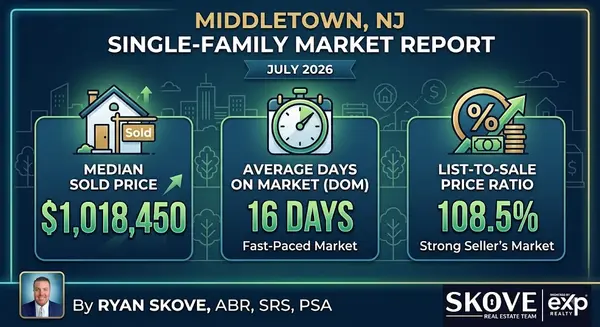
Middletown is the largest municipality in Monmouth County by population — a sprawling township that contains multitudes. The train station sits in the Lincroft/Middletown Village area, serving one of the most densely populated commuter catchments on the NJCL. Middletown's appeal has always been its combination of strong school districts, relative affordability compared to Rumson or Fair Haven, and highway access — but train access is the quiet engine underneath it all.
As Gateway improvements reduce delays and increase service frequency, Middletown's station area becomes more valuable, not less. The town has also been watching the ferry boom in nearby Atlantic Highlands, another reminder of how transportation improvements can rapidly reprice a market. Gateway is the long-term, structural version of that story.
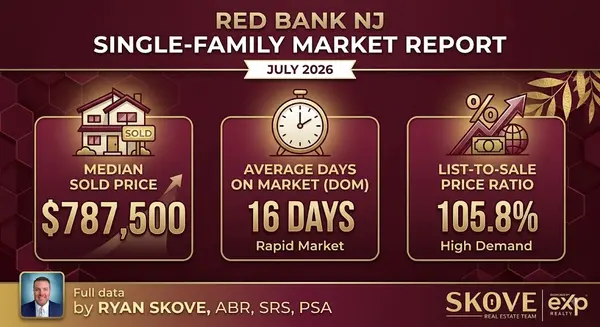
Red Bank is the cultural heartbeat of the Monmouth County market. A walkable downtown anchored by the Count Basie Center for the Arts, a thriving restaurant scene along Broad Street, luxury condos above the Navesink River, and one of the busiest NJ Transit commuter stations in the county. Red Bank has been the market that punches above its weight class for years — and that premium is deeply connected to its transit access.
Red Bank attracts the young professional cohort that drives appreciation: dual-income households where at least one partner commutes to Manhattan, wants a real downtown, and isn't willing to sacrifice either. Better trains mean more of those buyers looking to Red Bank. More buyers, compressed inventory, continued appreciation. The story writes itself.
Little Silver is one of the most quietly coveted addresses in Monmouth County. The borough is small, intensely residential, and studded with charming older homes on tree-lined streets — the kind of place that rarely has much for sale and rarely needs to advertise. The train station is a short walk or bike ride from most of the borough, making it one of the more walkable transit situations on the NJCL.
Little Silver's market has already priced in a significant transit premium — and that premium is poised to grow. As Gateway increases the reliability and capacity of the line, the value of being within walking distance of a functional, frequent commuter rail station compounds. For a borough this small and this established, Gateway is a rising tide that lifts every boat.
Long Branch is the southern terminus of the electrified NJCL — meaning every train that runs electric service ends here. The city has been in the middle of a genuine renaissance for the better part of a decade, with the Pier Village redevelopment and a steady influx of buyers seeking oceanfront living at a fraction of what comparable properties would cost in the Hamptons or Asbury Park. Median home prices have climbed to roughly $723,000 — up 4.7% year-over-year.
The Gateway Project matters enormously for Long Branch because commute reliability is the variable that has historically scared buyers away. The ride is long enough (~90 min) that buyers need to feel confident the train will run on time. A more reliable, higher-frequency service post-Gateway changes the psychological calculus. Long Branch transforms from a "brave lifestyle choice" into an obvious one.
What Does This Mean for Property Values in Monmouth County?
Let's get specific. Because "infrastructure is good for real estate" is a platitude. The actual data tells a more precise and more actionable story.
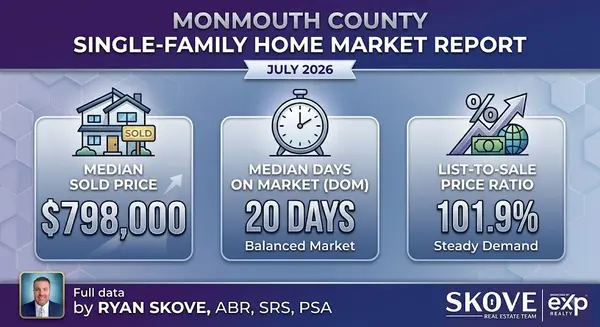
The baseline: Monmouth County's single-family home market posted a median sale price of $765,000 at year-end 2025 — a 9.0% year-over-year increase. The countywide median sat at $705,000 as of January 2026. These are not prices driven by speculation. They reflect genuine, sustained demand from buyers who prize the combination of shore lifestyle, school districts, and — above all — access to New York City.
The transit premium research is unambiguous. Studies from Rutgers University's Alan M. Voorhees Transportation Center, the National Association of Realtors, and the journal Transportation Research have all confirmed the same basic finding: homes within a half-mile of NJ Transit commuter rail stations command measurably higher values and appreciate faster than comparable properties farther away. The NAR's landmark study found residential properties within a half-mile of transit ran 4%–24% higher median sale prices. Research from Transportation for America found that transit projects increase nearby property values by 30%–40% over time.
Here's the analogy I use with clients: think of Gateway like installing a superhighway on-ramp at the end of your block. The on-ramp doesn't just make your commute faster — it makes your home more valuable to every buyer who might come after you. The train station is your on-ramp to the most valuable labor market in the world. When that on-ramp gets upgraded from two lanes to four, every house near it gets repriced.
With over a decade in corporate finance before real estate, I look at this through a risk/reward lens: Monmouth County NJCL towns currently trade at a discount to comparable Hudson County and Bergen County markets partly because the commute has historically been longer and less reliable. Gateway compresses both of those disadvantages. The discount narrows. Values appreciate.
The frequency effect is the underrated story here. The Gateway Program, when complete, doesn't just reduce delays — it allows NJ Transit to run significantly more trains. Currently, the bottleneck at the Hudson tunnels limits service to 24 trains per hour during peak. Post-Gateway, that ceiling is essentially lifted. More trains means off-peak service that actually works, which means more buyers can make the commute work on a hybrid schedule. In the post-pandemic era of 2-3 days per week in the office, the difference between a train every 60 minutes and a train every 20 minutes is the difference between the commute being feasible and it being a lifestyle choice.
The development multiplier. NJ Transit has already recognized what infrastructure investment does to station-area real estate. In October 2025, the agency unveiled a roadmap to develop its own 8,000-acre property portfolio — identifying potential for 14,000 to 20,000 housing units near transit stations over the next 30 years. Station-area TOD (Transit-Oriented Development) has historically driven some of the most durable appreciation in suburban New Jersey markets — look at Westfield, Cranford, and Millburn on the Morris & Essex Line for precedent. These are towns where station-area mixed-use development created a self-reinforcing cycle of investment, vibrancy, and home value appreciation.
Red Bank and Long Branch are already showing the earliest signs of this dynamic. As Gateway makes the NJCL more functional and competitive with the closer-in lines, expect more developer interest in station areas, more walkable mixed-use projects, and a further compression of the value gap between NJCL towns and their more expensive counterparts to the north.
What about the timeline risk? Buyers sometimes ask me: "If the tunnel doesn't open until 2035, why does it matter to me now?" The answer is that real estate markets price in anticipated future conditions — they don't wait for groundbreakings or ribbon cuttings. The Portal North Bridge improvement is already operational. The new tunnel is already under construction. Every milestone between now and 2035 is another data point that gets incorporated into local price discovery. The buyers who move on NJCL towns before the full service improvements are priced in historically capture the largest appreciation. The buyers who wait until 2035 to "see how it goes" will pay for the foregone optionality.
The Bottom Line
The Gateway Program is not a future promise. It is an active construction project with active funding, active legal protection, and an active workforce. The most visible near-term component — the Portal North Bridge — is already in service, already reducing delays on the North Jersey Coast Line. The tunnel boring machines are weeks away from beginning excavation. The trajectory is clear.
For Monmouth County, and specifically for the towns along the NJCL, this is the most significant structural tailwind for real estate values in a generation. Not because property values need a reason to be strong here — they don't, the market is already healthy — but because Gateway removes one of the persistent objections that has historically kept buyers looking at Bergen County or Morris County instead of Monmouth. The commute objection. The reliability objection. The "it's too far" objection.
When you can board a train in Red Bank or Long Branch and arrive at Penn Station on a schedule you can actually rely on — not just on a good day, but every day — the calculus for every buyer in this market changes. The shore lifestyle, which has always been the emotional draw, gets paired with practical commute infrastructure that competes with any market in the state.
In my experience working with buyers and sellers across Middletown, Red Bank, Little Silver, Long Branch, and throughout Monmouth County — the single biggest thing holding this market back from Bergen-level premiums has been the commute question. Gateway is the answer to that question, written in $16 billion and steel.
I'll be watching every milestone closely. And if you want to talk about what that means for your specific property, your neighborhood, or your decision to buy or sell — I'm always a phone call away.
Ready to Talk Monmouth County Real Estate?
Whether you're buying, selling, or just keeping an eye on the market — I bring finance expertise, local knowledge, and honest analysis to every conversation.
Contact Ryan Skove
Recent Posts