Summary of NJ Bill S4834 & The Arguments Against It
Summary of S4834 (Amended)
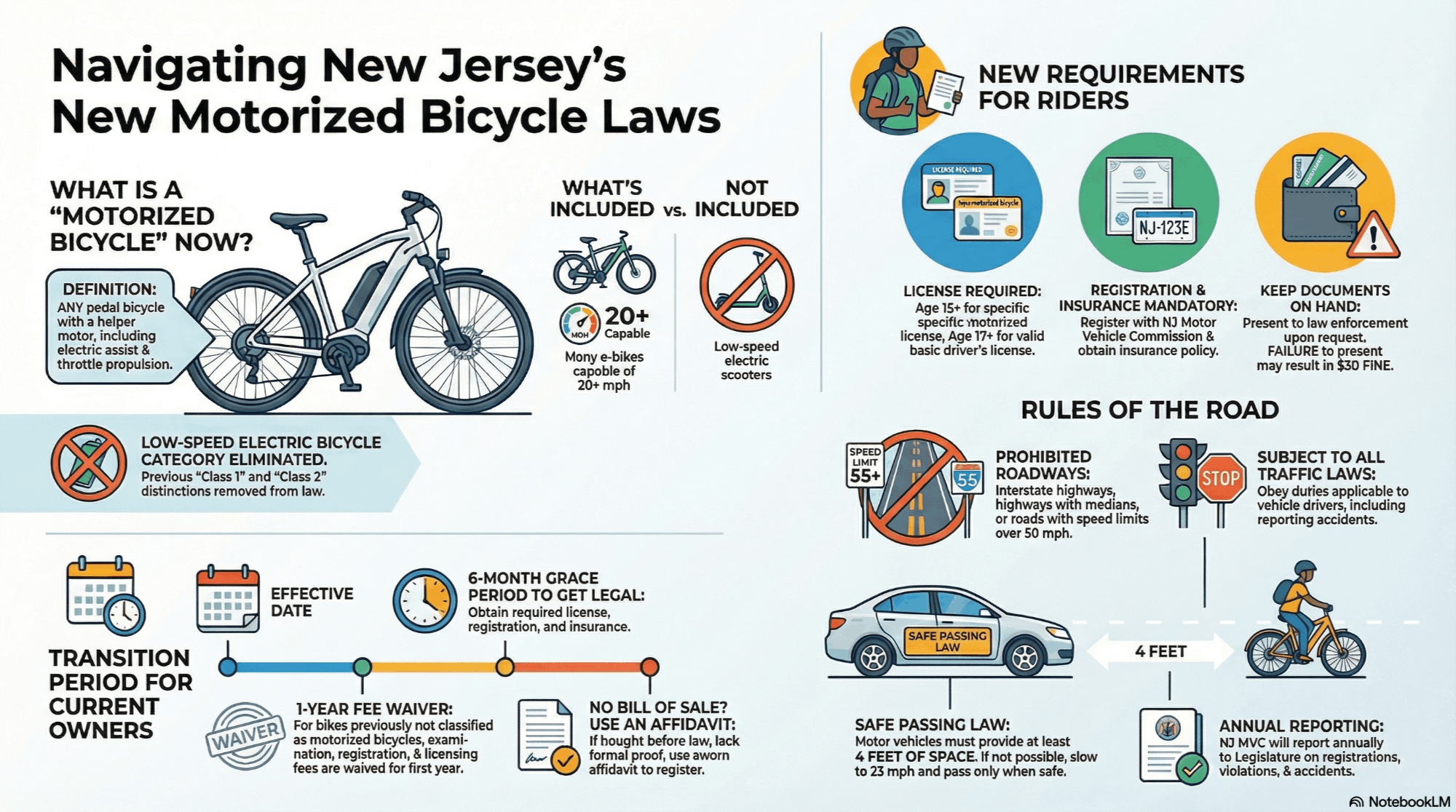
This bill fundamentally alters the legal status of electric bicycles in New Jersey, stripping them of their specific classification and regulating them identically to gasoline-powered mopeds.
- Total Reclassification: The bill deletes the definition of "low-speed electric bicycle" (Class 1 and 2) entirely. It expands the definition of "motorized bicycle" to include any pedal bicycle with an electric motor that provides assistance or exclusive propulsion via throttle.
- Mandatory Documentation: Operators are legally required to carry a valid driver's license, a registration certificate, and an insurance identification card at all times while operating the e-bike.
- Licensing and Age Restrictions:
- Operators must be at least 15 years old.
- Operators must possess a valid driver's license or obtain a specific "motorized bicycle license" which involves passing an exam and a practical demonstration of ability.
- Infrastructure Ban: The bill removes the statutory permission for electric bicycles to operate on bicycle paths. The amended text deletes "low-speed electric bicycle" from the section permitting use on paths, leaving that permission strictly for scooters.
- Amnesty and Grandfathering:
- Affidavits: The Motor Vehicle Commission (MVC) allows owners without bills of sale to submit sworn affidavits to prove ownership for registration.
- Fee Waiver: There is a one-year waiver for examination, registration, and licensing fees for e-bikes not previously classified as motorized bicycles.
- Grace Period: Owners have six months from the effective date to obtain the required insurance, registration, and licenses.
Arguments Against S4834
The following arguments highlight the negative impacts of S4834, focusing on costs, industry disruption, and the administrative capacity of the NJ MVC.
1. Financial Burden on Individuals and Reduced Mobility
The reclassification of e-bikes from consumer electronics to motor vehicles imposes immediate and recurring costs on residents, disproportionately affecting lower-income riders who use e-bikes for affordable commuting.
- Mandatory Insurance Costs: The bill mandates that operators possess an "insurance identification card". Standard homeowners' or renters' insurance often excludes motorized land vehicles. Riders will be forced to purchase specialized motorcycle or moped liability policies, which may cost hundreds of dollars annually—potentially exceeding the value of cheaper e-bikes.
- Recurring Fees: While the bill offers a one-year fee waiver, riders will eventually be subject to standard MVC fees for registration and licensing.
- Barriers to Youth Mobility: Current law generally permits teenagers to use Class 1 e-bikes. By raising the age to 15 and requiring a license, the bill restricts independent mobility for teenagers traveling to school or employment.
- Criminalization of Administrative Errors: Failure to carry these documents results in a fine of up to $50. Furthermore, submitting an affidavit for ownership with errors could be prosecuted as a fourth-degree crime.
2. Disruption of the Electric Bicycle Industry
The bill decouples New Jersey from the national regulatory standard, creating a hostile market environment.
- Regulatory Isolation: Most of the United States utilizes the 3-Class system (Class 1, 2, and 3). This bill specifically deletes the labeling requirement for classification, speed, and wattage. Manufacturers producing bikes for the North American market may find their inventory legally ambiguous in New Jersey, where a standard pedal-assist bike is now legally a "moped."
- Sales Impact: The requirement for registration and insurance creates high friction at the point of sale. Bicycle retailers, who are not licensed motor vehicle dealers, may be unable to legally register the vehicles for customers, forcing buyers to navigate the MVC process independently. This loss of "ride-out-the-door" convenience will likely decimate sales.
- Inventory Obsolescence: Retailers holding stock of "low-speed electric bicycles" now hold stock of "unregistered motor vehicles," complicating liability and insurance for test rides.
3. Logistical Nightmare for Implementation
The practical application of registering tens of thousands of bicycles as motor vehicles presents severe logistical flaws.
- Lack of VIN Standardization: Motor vehicle registration relies on 17-digit VINs. Bicycles have non-standardized serial numbers that are often duplicated across brands or difficult to locate. The bill attempts to solve this with "sworn affidavits", but this relies on a manual, paper-heavy process that is prone to error and fraud.
- Infrastructure Confusion: By removing the explicit permission for e-bikes to use "bicycle paths", the bill effectively forces slow-moving e-bikes onto roadways with faster, heavier traffic, increasing the likelihood of fatal collisions.
4. The NJ MVC Capacity Crisis
The New Jersey Motor Vehicle Commission (MVC) faces a critical capacity challenge in implementing this bill.
- Overburdened System: The MVC is currently tasked with issuing "REAL ID" licenses and identification cards to comply with federal standards,. This process has historically caused significant delays and long wait times. Adding a requirement to register a massive new class of vehicles—most of which lack proper title documents—will exacerbate existing backlogs.
- Testing Bottlenecks: The bill requires the MVC to administer practical operating exams for riders without driver's licenses. The MVC must designate municipalities or agents to oversee these tests. Setting up a statewide testing network for bicycle operators is a massive bureaucratic undertaking that the MVC is unlikely to execute efficiently within the six-month grace period.
- The "Affidavit" Processing Load: Reviewing thousands of individual sworn affidavits for ownership is a manual, time-consuming legal review process that differs significantly from the automated processing of standard manufacturer certificates of origin (MCOs) used for cars.
Analogy
Treating electric bicycles as "motorized bicycles" (mopeds) is akin to requiring a fishing license and vessel registration for a child’s inflatable pool raft. While the raft technically floats (like a boat), subjecting it to the same bureaucratic and financial rigor as a commercial vessel destroys its utility, overwhelms the registration agency with low-value paperwork, and criminalizes casual users who simply want to enjoy the water.
Recent Posts