
New Jersey Kids Code Act: What It Means for Families
Skove Real Estate Team • eXp Realty • Red Bank, NJ • NJShoreRealtors.com
New Jersey Kids Code Act: What the New Online Safety Law Means for NJ Families
On August 12, 2026, Governor Mikie Sherrill signed the New Jersey Kids Code Act into law, making New Jersey the sixth state to adopt an age-appropriate design code for online platforms. The law -- formally A4015/S3413 -- doesn't ban anything kids can see. Instead, it changes how the largest online platforms have to build their products for anyone under 18: stricter default privacy settings, limits on notifications and targeted ads, and new restrictions on the design tricks that keep people scrolling. Covered platforms have until September 1, 2027 to comply.
Here's what's actually in the law, who it applies to, and why a piece of tech policy is worth a few minutes of a Monmouth County family's attention.
What Changes for Kids Online
Think of the law as a building code, not a content filter. It doesn't say what a 13-year-old is allowed to watch or read -- it says how a platform has to be wired once it knows a user is a minor. A few of the biggest changes:
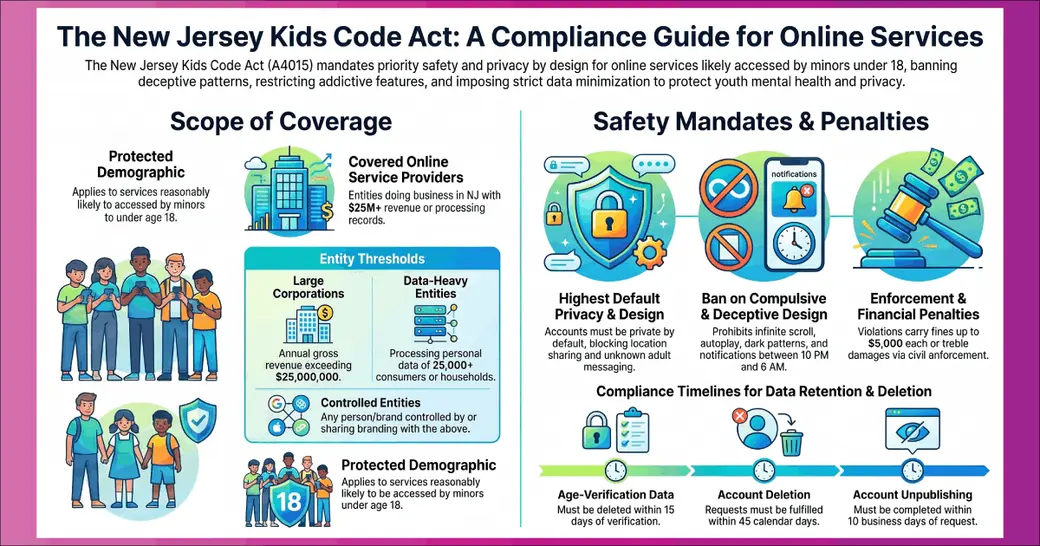
- Privacy defaults flip to "on." For known minors, platforms have to default to the highest privacy setting available: private accounts, hidden connections lists, hidden location, no search-engine indexing, and interaction counts (likes, comments, reshares) turned off unless the user chooses to turn them on.
- No notifications by default -- and a curfew when they are on. Platforms can't push notifications to a known minor between 10 p.m. and 6 a.m., and during the school year, weekday notifications are blocked from 8 a.m. to 4 p.m. as well.
- No targeted ads for age-restricted products. Alcohol, tobacco, gambling, and narcotics ads can't be targeted to a known minor.
- No "dark patterns." Interface tricks designed to manipulate a minor's choices -- the FTC's own term for it -- are off the table.
- Compulsive-use design gets reined in. Platforms have to take reasonable steps so their data use and design choices don't drive compulsive use in minors.
That last point is worth an analogy: a slot machine doesn't tell you when to stop pulling the lever -- the variable, unpredictable payout does that job for it. The bill calls out several of those same mechanics by name as "covered design features" -- see the table below.
Covered Design Features -- In Plain English
| Design Feature | What It Means |
|---|---|
| Infinite scroll/autoplay | Content keeps loading or playing automatically, with no natural stopping point—like a treadmill that never signals the end of the workout. |
| Gamification | Streaks, badges, and rewards that push someone to keep opening the app so they don't "lose" progress. |
| Notification clustering/timing | Notifications timed or bundled specifically to pull a user back into the app, regardless of content. |
| Virtual currency / digital items | In-app currency or purchasable items that encourage continued engagement or spending. |
| Appearance-altering filters | Filters that change how someone looks, tied to features known to affect self-image. |
| Forced account creation | Repeatedly prompting account sign-up just to view content that's already public. |
| Ephemerality prompts | "This disappears in 24 hours"-style urgency nudging someone to check now. |
| Variable reward schedules | The slot-machine mechanic -- unpredictable rewards that keep someone checking "just in case." |
Source: Section 3, definition of "covered design feature," New Jersey Kids Code Act (A4015, Third Reprint).
Who Actually Has to Comply
Not every website with a teenage visitor is covered. Three things have to be true at once:
- The company does business in New Jersey, and
- Its online service is reasonably likely to be accessed by a child or minor -- generally meaning at least 2% of its audience is age 2–17, or it's already treated as "directed to children" under federal COPPA rules, and
- It either has annual gross revenue over $25 million, or processes the personal data of 25,000+ consumers or households a year.
Size alone doesn't pull a company in, though -- the type of site matters just as much. The law defines a covered "online service" narrowly: it must display content generated by account holders and allow those account holders to interact with each other's content as a central feature of the service. A useful way to picture the line: a phone directory lets you look someone up, but a group chat lets you talk to them and see what they post. The law is aimed at the group chat, not the directory.
Quick gut check: Email services, broadband/telecom services, and sites that simply sell or deliver a physical product are excluded outright. A typical real estate brokerage site or IDX listings feed -- which displays property data rather than letting users interact with each other's content -- generally falls outside the definition too, unless it adds social or community features. Apps that are purely direct-messaging tools are also carved out.
Enforcement: What's at Stake for a Violation
| Who Can Act | What They Can Get |
|---|---|
| NJ Attorney General | Treats a violation as an unlawful practice under the state Consumer Fraud Act; can investigate, sue, and enter into assurances of discontinuance. |
| A covered child or minor | Can sue the platform directly -- New Jersey is the first state to enact a design code with this kind of individual private right of action. |
| A parent, on the child's behalf | Can bring the same civil action on behalf of their child. |
| Court-awarded remedies | $5,000 per violation or treble damages (whichever is greater), punitive damages for reckless or knowing violations, injunctive and declaratory relief, and attorney's fees. |
Source: Section 14, New Jersey Kids Code Act (A4015, Third Reprint).
Timeline: How We Got Here
| Date | Milestone |
|---|---|
| June 8–11, 2026 | Assembly and Senate committee substitutes adopted (A4015, S3413) |
| June 30, 2026 | Passed the Assembly 73–5 and the Senate 36–4 |
| August 12, 2026 | Signed into law by Governor Mikie Sherrill, as part of a broader kids' online safety package |
| September 1, 2027 | Compliance deadline -- law takes effect |
Why This Matters for Monmouth County Families
This isn't a real estate story in the traditional sense -- but it's the kind of local-impact policy that's worth tracking for the same reason a good school district report or a new township ordinance is: it shapes daily life for the families who call the Jersey Shore home. As a Middletown Township Housing Commissioner as well as a Realtor, I try to keep an eye on the local and state-level issues that matter to buyers and sellers beyond just the transaction -- and youth online safety, with New Jersey now among the more aggressive states on this front, is squarely one of them.
Frequently Asked Questions
What is the New Jersey Kids Code Act?
It codifies the New Jersey Age-Appropriate Design Code, requiring online platforms likely to be used by children and teens to implement stronger default privacy settings, restrict data collection, limit compulsive-use design features, and curb targeted advertising directed at minors. Governor Sherrill signed it into law on August 12, 2026, effective September 1, 2027.
Which companies have to comply with the law?
A "covered online service provider" that does business in New Jersey, whose online service is reasonably likely to be accessed by a child or minor, and that either has annual gross revenue over $25,000,000 or processes the personal data of at least 25,000 consumers or households a year.
What's the difference between a covered child and a covered minor?
A "child" is under 13; a "minor" is 13 through 17. The law's obligations only kick in once a platform has "actual knowledge" of a specific user's age.
What do covered platforms actually have to change for young users?
Highest privacy settings by default, no default or late-night/school-hours notifications, no targeted ads for alcohol, tobacco, gambling, or narcotics, no dark patterns, and reasonable limits on compulsive-use design features like infinite scroll and streak-based gamification.
Can parents sue a company that violates the law?
Yes. A covered child or minor -- or their parent, on their behalf -- can sue directly. Courts can award $5,000 per violation or treble damages, whichever is greater, plus punitive damages, injunctive relief, and attorney's fees. The Attorney General can also enforce it as a violation of the Consumer Fraud Act.
Does the law apply to real estate or local business websites?
Generally, no. A covered "online service" must display user-generated content and allow account holders to interact with each other's content as a central feature. A typical real estate or listings-based site doesn't meet that bar unless it adds social or community features.
When do companies need to be in compliance?
September 1, 2027 -- the first day of the 13th month after the August 12, 2026 signing.
Stay in the Loop on Local Jersey Shore News
From market reports to the state and local policy shaping life along the Jersey Shore, I keep Monmouth County families informed. Have a question about how this or another local issue affects your family or your home search?
Contact Ryan Browse More Local Insights